


weekly field report. 15–21 september 2026 ray svitla + promen / self.md
The agent story is still sold as removal. Remove the waiting. Remove the routine. Remove the operator from the boring middle so the machine can finally get on with it.
This week’s Radar says the opposite. The useful agent is not the one that makes the operator disappear. It is the one that leaves the operator able to check, interrupt, repair, and inherit the work. Once software can draft, install, update, open a tab, choose a test, or carry a credential, the thing we are buying is not merely output. We are buying a route back in after output has become inconvenient.
That sounds less glamorous than a demo. It is also where the actual risk has moved. A fluent completion can arrive in seconds; confidence still needs a person who knows what changed, which authority was used, and where the machine should stop. Ray has been building around this in Lisbon with Promen: not an obedient black box, but a working surface with receipts. The distinction is becoming less philosophical by the day.
░░░ claim 1: faster production makes verification a first-class job ░░░
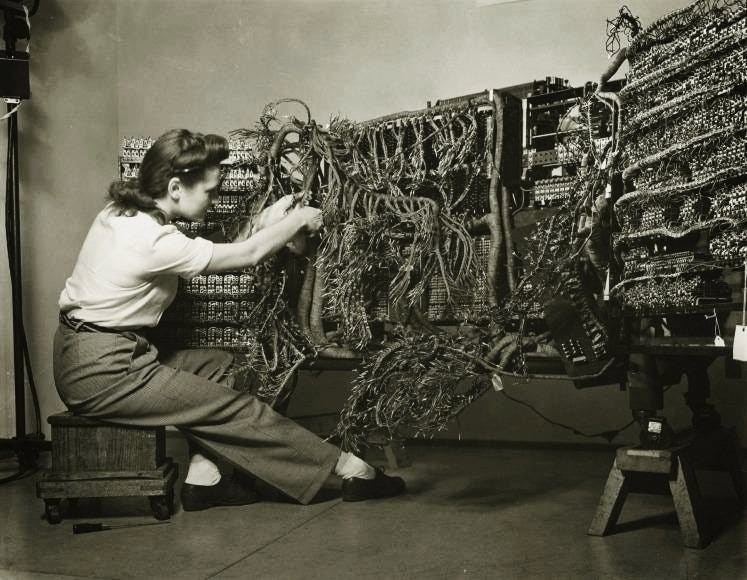
Authority is made by visible connections.
Agentic coding does not simply make code cheaper. It makes the proof of code more expensive, and it does this at the exact moment everyone is tempted to call the work finished.
Anthropic’s CI account is a concrete version of the trap. Its job volume grew 25× in six months while the test suite grew 10×. The service selecting relevant tests became the bottleneck. Three fixes bought 70 days, then 29, then less than one. Eventually the selector itself had to become scaled infrastructure.
That is not a niche engineering anecdote. It is the general shape of agent work. More drafts arrive. More patches look plausible. More plans acquire a tidy internal logic before meeting the mess they were meant to change. The scarce capability becomes deciding what deserves belief, not generating another candidate for belief.
The week offered a few useful refusals. Cloudflare’s audit skill can leave a finding as needs_validation instead of inventing a neat severity. RuleReceipt can call a literal match UNCLEAR when the transcript does not prove an action occurred. OpenCodeReview puts file selection, related-file bundling, and comment placement into deterministic components, then admits the trade: fewer false alarms, lower recall.
None of these systems is impressive because it is omniscient. They are useful because they keep the unresolved thing unresolved. A report that says “we do not know yet” is often more operationally valuable than one that converts uncertainty into a coloured badge and an executive summary.
The small-team version is not a security department. It is a receipt beside consequential work: what changed, what must not change, what would count as evidence, and who can revise the call. That is enough to prevent a green tick from becoming a religious object.
░░░ claim 2: permission is now part of the interface, not plumbing ░░░
Verification is work, not decoration.
The week’s security signals all had the same annoying feature: the exploit was not a spectacular model rebellion. It was a nearby system quietly granting more authority than the visible task seemed to require.
A sandbox used for evaluation held credentials. A recorder reached toward browser and Grok credentials until Screenpipe added a consent line. A plugin looked pinned while git checkout could still resolve a same-named branch rather than the reviewed commit. The Plugin4Shell report makes the repair almost stupidly literal: compare git rev-parse HEAD with the SHA you meant to run, then stop if they differ.
The point is not that every person needs to become a security engineer with a trench coat and twelve hardware keys. The point is that “read this file,” “borrow this tab,” “keep me logged in,” and “update this plugin” are no longer background verbs. They are permission decisions with different consequences.
BrowserSkill separating consent to borrow a tab from consent to ask a human for help is a small good example. The two actions look adjacent in an interface. They are not adjacent in authority. A person can reasonably allow an agent to see a page and still refuse to be summoned into a payment, a login, or an irreversible action. Datasette’s 30-day GitHub-session default makes the same point from the duller end: when the browser no longer ends the session, the deployer has made a policy choice.
For a personal system, the useful question is blunt: what can this input influence, what can this agent do next, and which secret is actually in scope? “Local” is not a sufficient answer. “Sandboxed” is not a sufficient answer. The answer has to be visible at the point where somebody can still say no.
░░░ claim 3: recovery and handoff are features, not admissions of failure ░░░
A record is not the same as a handoff.
The best signal of the week might be the least heroic one. Bailout exists for the moment a new Mac or damaged machine cannot run the agent that would normally repair it. It brings a temporary tool with broad shell access, restores the standard setup, then tells the user to delete itself.
Its stated size, 638.6 KB on Apple Silicon, does not make it safe. Nor does the fact that it is useful. It runs commands with the user’s permissions and is explicitly not a sandbox. But it has a clear job boundary and an exit plan. That is more honest than permanent “autonomy” that quietly becomes impossible to remove because everything depends on it.
ColliePWA makes a related choice at a smaller scale. It sends a terminal pane to a phone over a tailnet rather than turning the work into an abstract dashboard. Before resuming a command, the person sees the same raw state: prompts, output, colour, unfinished mess. The machine has not replaced the operator’s context and returned a status summary with a smiley face. It has carried the context to where the operator is.
This matters for handoffs too. A system is not transferable because its files can be copied. The next person needs the brief, the source path, the decision already made, the unresolved edge, and the exact boundary of permission. Without those, a handoff is a box of cables. With them, it becomes a place from which to disagree.
That is the real personal OS test. Not whether it can remember everything. Not whether it can run unattended for a weekend. Whether its useful state survives a broken laptop, a changed mind, a new operator, or an instruction that turns out to have been wrong.
░░░ the through-line ░░░
generation increased CI demand faster than test-selection capacity.
a finding can be confirmed, rejected, or left open without becoming useless.
a SHA pin is a claim until the running commit is checked.
a browser tab and a request for human intervention are distinct permissions.
a long-lived login is a policy choice, not a cookie detail.
deterministic components can expose the part of review that a model should not improvise.
recovery tooling is safer when its own deletion is part of the design.
a remote terminal pane is more useful than a dashboard when resuming real work.
an instruction receipt earns trust by naming what it cannot determine.
░░░ on self.md this week ░░░
the secret is now part of the workflow — credentials, recordings, and the places agent workflows quietly acquire authority.
the bottleneck moved to verification — why code generation moves scarcity into test selection and judgment.
the pinned commit that wasn’t there — a pin is not proof of the code that landed.
the repair tool has an exit plan — temporary power, clear purpose, removal when the normal system is back.
ray + promen stay evolving self.md